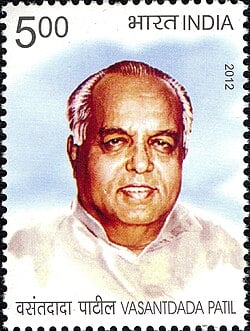
A legendary freedom fighter, statesman, and agrarian reformer from Maharashtra, Vasantdada Patil was instrumental in turning Western Maharashtra’s rural belt into a world-class cooperative hub. Starting as a grassroots farmer, he spearheaded the establishment of cooperative sugar factories, rural credit institutions, and educational societies. His policy decisions as Chief Minister—including liberalizing higher and technical education—allowed cooperative trusts to set up engineering and medical colleges across rural regions, creating an integrated model of social and economic upliftment.
November 13, 1917 – March 1, 1989
- Primary/Secondary Education: Completed schooling up to the Vernacular Final in Sangli before dedicating himself full-time to agriculture and the freedom struggle.
- Parents: Banduji Kadam Patil (Father)
- Spouse: Malatitai Patil (First Wife, d. 1960s); Shalinitai Patil (Second Wife, former Minister and MLA)
- Children: Prakashbapu Patil (Son, former Member of Parliament)
- Grandchildren: Pratik Patil and Vishal Patil (former Union Minister and MP)
- Shetkari Sahakari Sakhar Karkhana (Sangli): Founder and Chairman, building one of the largest single-unit cooperative sugar complexes in Asia.
- Sangli District Central Co-operative Bank: Founder Chairman, establishing institutional agricultural credit lines across South Maharashtra.
- Maharashtra State Co-operative Bank (MSCB): Chairman, driving capital mobilization for rural agro-industries.
- National Federation of Cooperative Sugar Factories (NFCSF): Senior Executive Director and President.
- Public & Governmental Roles: Chief Minister of Maharashtra (three terms: 1977–1978, 1983–1985); Governor of Rajasthan (1985–1987); Union Member of Parliament (Lok Sabha).
- Integrated Agro-Industrial Ecosystem: Expanded cooperative sugar processing into secondary and tertiary industries, including distilleries, paper mills, and co-generation power plants managed directly by farmer-owned boards.
- Cooperative Education Policy Reforms: Introduced visionary legislation in Maharashtra allowing non-government, self-financed cooperative trusts to establish engineering, medical, and polytechnic institutes in rural areas, democratizing professional education for farmers' children.
- Policy whitepapers, legislative addresses, and organizational essays on cooperative sugar pricing, drought-relief management through credit unions, and decentralized rural administration.
- Padma Bhushan (1967): Conferred by the Government of India for distinguished service in social work and the cooperative movement.
- Institutional Commemorations: Honored by institutions nationwide, including Padmabhushan Vasantdada Patil Pratishthan's College of Engineering (Mumbai) and commemorative postage stamps issued by India Post.