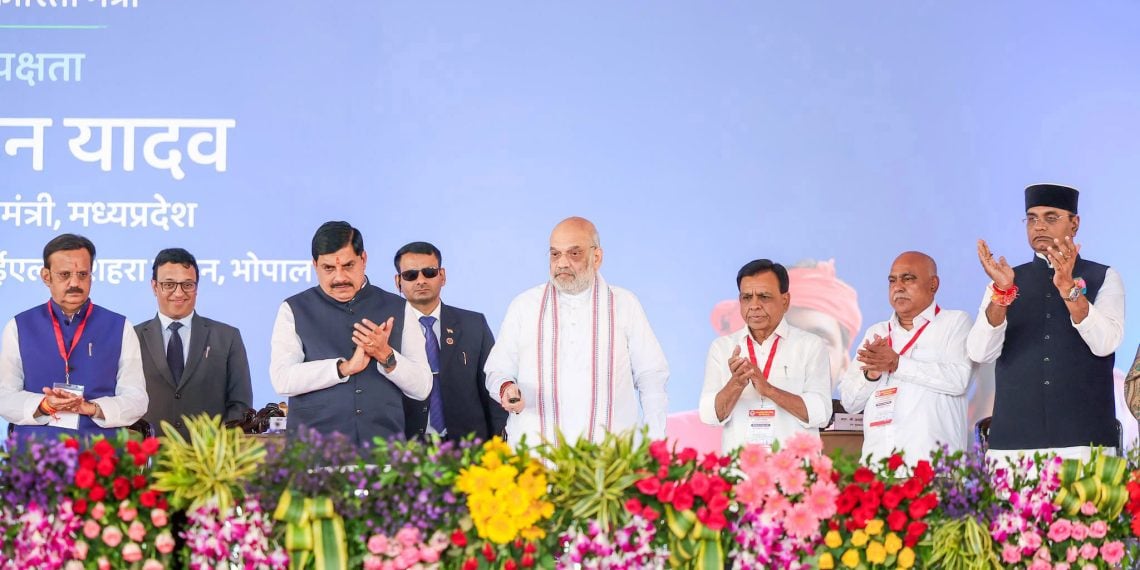
Bhopal, October 3, 2026: Union Home and Cooperation Minister Amit Shah has called for expanding cooperative dairying in Madhya Pradesh to improve the incomes of livestock farmers, increase women’s participation in the rural economy and strengthen village-level economic activity.
Addressing the Gaupalak Sammelan in Bhopal, Shah said dairy cooperatives can help livestock rearers reduce their dependence on open-market sales and intermediaries by providing organised markets and better price realisation. He also emphasised the importance of expanding processing and value addition so that farmers can benefit from products such as butter, ghee, cheese, ice cream and mawa.
Shah highlighted the growth of India’s dairy sector, noting that milk production has increased from around 14.60 crore tonnes in 2014–15 to approximately 24.80 crore tonnes. Per-capita milk availability has also risen by about 58%, from 307 grams to 485 grams per day. Dairy exports have reached nearly ₹4,666 crore, according to figures cited during the address.
He also underlined the role of White Revolution 2.0, which aims to establish 75,000 new cooperative dairies and strengthen around 46,000 existing dairy cooperatives across the country. Madhya Pradesh is expected to be an important beneficiary of the expansion, enabling livestock farmers to gain improved access to cooperative markets, processing infrastructure and organised dairy networks.
The Madhya Pradesh government has set a target of increasing daily milk procurement from around 12 lakh kg to 52 lakh kg. The Centre has assured support for achieving the target.
Breed improvement was identified as another key area. In-principle approval has been given for 50 acres of land for cattle and buffalo breeding programmes. Technologies such as sex-sorted semen are expected to support productivity improvement while also contributing to the conservation and development of indigenous breeds.
Shah also highlighted the potential of the dung economy as an additional source of rural income. The approach includes scientific collection and utilisation of cattle dung, methane reduction, clean energy generation and nutrient recycling.
Five technology-based models have reportedly been developed to convert dung into useful products and create additional economic opportunities for livestock-owning households.
Women’s participation was another major theme of Shah’s address. He described dairy cooperatives as an important mechanism for women’s economic empowerment, particularly because cooperative dairy payments can place income directly in the hands of women.
According to Shah, strengthening women’s participation in dairy activities can contribute not only to household incomes but also to broader rural development and efforts to address malnutrition.
The Bhopal programme also highlighted several new dairy-sector investments. These include a ₹255-crore milk processing plant in Ujjain with a capacity of 3 lakh litres per day, a product dairy plant in Bhopal and a state-level central laboratory.
The programme also witnessed the exchange of an MoU between KRIBHCO and the Madhya Pradesh State Biodiversity Board for developing an urban forest under the Morvan Project.
The initiatives reflect the government’s broader focus on using cooperative institutions, dairy infrastructure, technology and value addition to create stronger and more sustainable income opportunities for livestock farmers under the “Sahkar Se Samriddhi” approach.