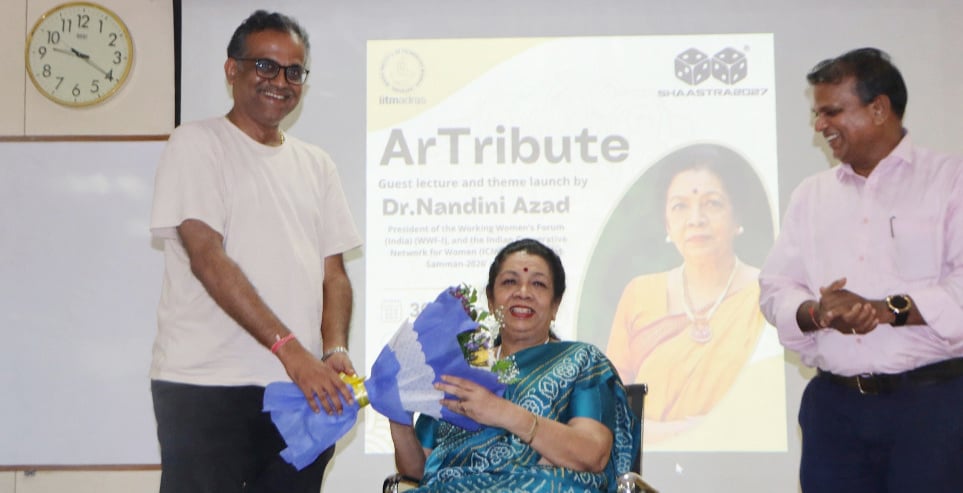
Chennai: Grassroots women’s cooperatives can help economically vulnerable women move from informal work and financial insecurity towards asset ownership, leadership and greater decision-making power, said Dr. Nandini Azad, President of the Working Women’s Forum (India) and Indian Cooperative Network for Women (ICNW).
Azad was speaking at the launch of the ArTribute 2026 theme, “Shades of Her – Tribute to Women,” organised through the Shaastra platform of IIT Madras. She said technological and economic development should not be measured only by growth and innovation, but also by whether it creates greater agency and opportunities for people, particularly women working in the informal economy.
She highlighted the importance of bringing science, technology and women’s empowerment together and appreciated IIT Madras and the Shaastra team for providing a platform for such discussions.
Drawing on her experience of working with women’s cooperatives, Azad noted that more than 90% of poor women workers in India are part of the informal economy, where workers often face limited access to finance, bargaining power, institutional support and regulatory protection.
The Working Women’s Forum (WWF) and Indian Cooperative Network for Women (ICNW) began working with women from economically vulnerable communities in 1978 and 1981, respectively. Their network now includes more than 600,000 women members across Tamil Nadu, Karnataka, Andhra Pradesh and Telangana, engaged in 262 occupations, ranging from agriculture and fishing to vending, poultry, weaving and food-related enterprises.
Azad said the organisations have provided nearly ₹500 crore in small loans, while combining financial support with gender awareness, leadership development, enterprise diversification and asset-building initiatives.
She cited the experience of Padmavathy to illustrate how access to successive rounds of credit can help women build productive assets. Beginning with a livelihood supported through grain wages, Padmavathy gradually acquired bullocks, agricultural equipment and farmland through loans. Over time, she became involved in decisions relating to crop selection and marketing, while her family expanded its activities into farming and dairy.
According to Azad, 38% of ICNW women members have acquired land titles in their own names, strengthening their economic position and participation in household decision-making.
She described this approach as “Accumulation at Base”, under which women progress from access to finance and education towards diversified livelihoods, asset ownership and community leadership.
Azad also highlighted the role of technology in strengthening women-led cooperative institutions. During the pandemic, 65 CEOs, branch managers and women leaders were trained in digital transactions, NEFT and UPI.
The network also operates a software unit staffed by young women engineers from labour and fishing communities, demonstrating how technology can become part of the institutional development of grassroots organisations.
The experience of WWF and ICNW has also extended to international platforms, with participation in UN commissions, COP27, COP28, the G20 Social Summit and global cooperative forums.
Azad argued that the experience of the organisations demonstrates that women from economically disadvantaged backgrounds can successfully manage institutions when they receive access to finance, training, technology and leadership opportunities.
Addressing the young audience at IIT Madras, she called for greater collaboration between technology and grassroots organisations. The larger goal, she said, should be to create an environment in which women are not merely beneficiaries of development but become owners, decision-makers and leaders in their families, enterprises and communities.