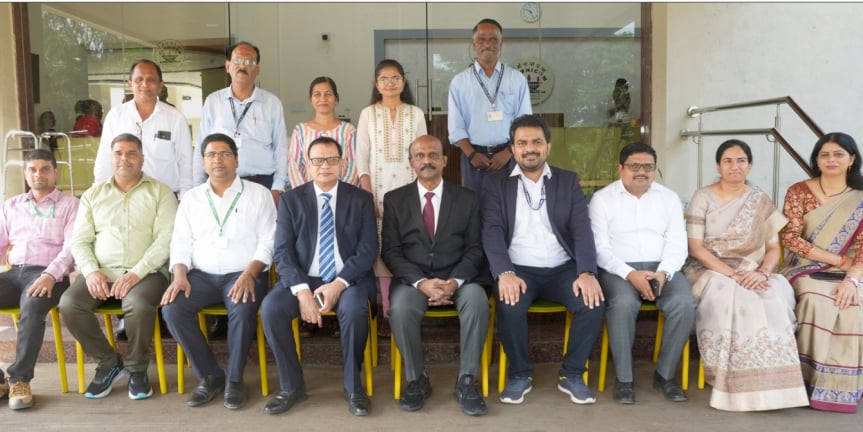
The programme, titled “Cooperative Business Model including MSCS Act, 2002,” brought together officials from the Central Registrar of Cooperative Societies (CRCS), Cooperative Election Authority (CEA) and Cooperative Ombudsman. It was organised with the support of the Ministry of Cooperation, Government of India.
The programme was inaugurated by Dr. Suva Kanta Mohanty, Director of VAMNICOM and CICTAB. Highlighting the importance of sound governance, regulatory accountability and member-centric management, Dr. Mohanty stressed that professional management practices and effective implementation of the regulatory framework are essential for the long-term sustainability and credibility of cooperative institutions.
Dr. D. Ravi, Programme Director, outlined the programme’s objectives and emphasised the importance of combining classroom learning with field-level exposure. He noted that visits to different cooperative institutions would help participants gain practical insights into business models, management systems, governance arrangements and operational challenges.
The programme combined expert-led sessions on the Multi-State Cooperative Societies (MSCS) Act, 2002, and audit practices with visits to prominent cooperative institutions across Maharashtra.
On October 6, participants attended a session on the MSCS Act conducted by S. B. Patil before visiting Cosmos Co-operative Bank Ltd. and Venkateshwara Co-operative Power and Agro Processing Ltd.
The following day, sessions on audit and the MSCS Act were conducted by S. B. Patil, Smt. Shilpa Kadu, Deputy Registrar, Pune, and Jagadeesha M, SCO. These sessions were followed by a visit to Tuljabhavani Urban Multistate Cooperative Credit Society Ltd.
On October 8, the officials visited Shivsahyadri Sahakari Patpedhi Maryadit and Saraswat Co-operative Bank Ltd. The visits provided opportunities to understand cooperative credit operations, governance structures and member services.
The final day included visits to IFFCO, Annapoorna Parivar and Katraj Dairy, offering insights into the functioning of a large cooperative organisation, dairy operations and community-oriented initiatives.
The programme concluded with participant presentations, action-plan discussions, evaluation, feedback and valedictory remarks.
Participants identified four critical dimensions of effective cooperative functioning: member-centricity, governance, business sustainability, and regulation and accountability.
The discussions highlighted that the performance of cooperative institutions depends not only on statutory compliance but also on transparent decision-making, clearly defined management responsibilities, sound financial systems and responsiveness to members’ needs.
Participants proposed several measures in their action plans, including adopting member-centric approaches to governance and compliance, strengthening the analytical review of audit, inquiry, inspection and statutory compliance matters, and sharing their learning with colleagues and cooperative institutions.
The deliberations reinforced the need to integrate legal knowledge, professional management and practical field experience to improve institutional accountability and safeguard members’ interests.
The programme was conducted under the overall guidance of Dr. D. Ravi. VAMNICOM faculty members Dr. Amit Borkar and Dr. Arvind Darshna coordinated the field visits and facilitated interactions with the participating institutions.
The participating officials included Arun Kumar Singh and Sanjay Kumar, Under Secretaries, along with Aditya, Kuldeep Singh Ranga, Smt. Kamla Masiwal and Smt. Lalita Choudhary.
VAMNICOM functions under the National Council for Cooperative Training and is promoted by the Ministry of Cooperation, Government of India. Through management education, training, research, consultancy and capacity-building initiatives, the institute works to strengthen professional management and institutional accountability across the cooperative sector.
The exposure programme provided a platform for cooperative regulators to connect the legal and regulatory framework with practical institutional experience, with the broader objective of supporting transparent, professionally managed and sustainable cooperative organisations.